
The Serbian National Theatre in Novi Sad opens the Balkan Theatre Festival
___________
THE GOSPEL ACCORDING TO F. M. DOSTOEVSKY
Jernej Lorenci's performance
The Slovenian director Jernej Lorenci – one of the leading names in contemporary European theatre – once again brings fragments of the classical literary heritage to the stage in his characteristic minimalist style. Following The Iliad (Slovenian National Theatre), Orpheus (National Theatre “Ivan Vazov”), and many others, he now turns to the work of Fyodor M. Dostoevsky, creating a magnificent mosaic stage narrative inspired by the novels Crime and Punishment, The Brothers Karamazov, Demons, and The Insulted and Injured.
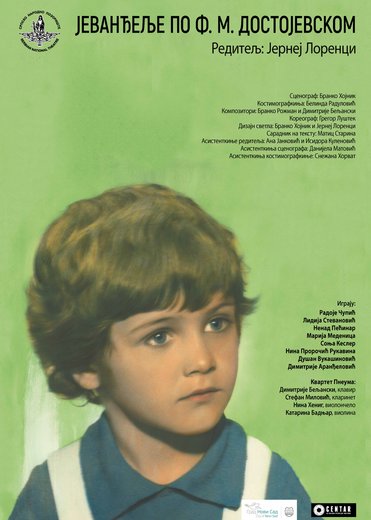
Instead of following Dostoevsky’s narratives literally, Lorenci and dramaturg Matic Starina weave together separate scenes, transforming them into a poetic and philosophical tableau focused on some of the most pressing existential questions: Does God exist, and if so—why does He allow suffering? And if not—where, then, is hope? The suffering of children emerges as the leading leitmotif of the performance, turned also into a powerful visual symbol—the image of the young Raskolnikov appears on the poster as both a warning and a call.
The actors do not play Dostoevsky’s characters in the classical sense; instead, they recount their stories in the spirit of epic theatre. This deliberate distance from traditional dramatic role-playing does not weaken but rather intensifies the emotional impact of their performances.
The power of the production lies in its rhythm—a dynamic alternation of restrained, quiet moments and bursts of emotion and philosophical expression.
Thus, The Gospel According to F. M. Dostoevsky becomes a theatrical event that does not merely “retell” Dostoevsky, but translates him into a stage language that is alive, contemporary, and painfully relevant.


